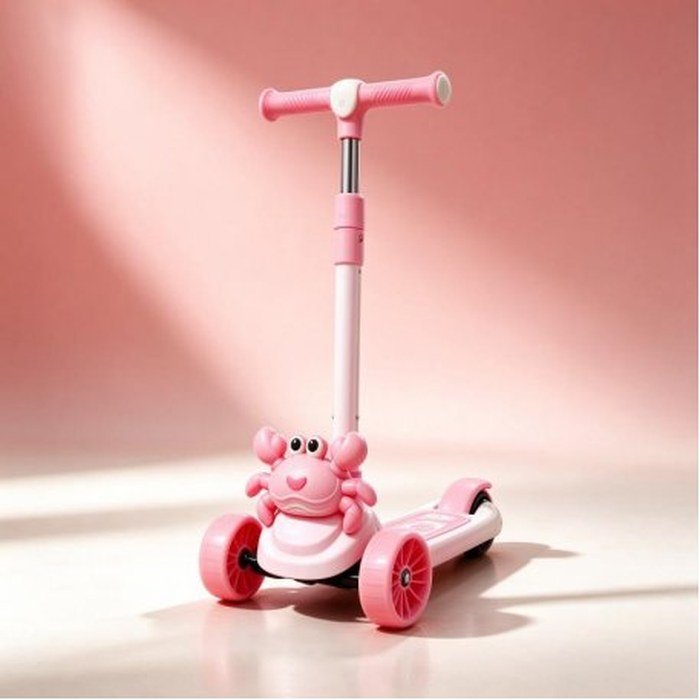
A kids scooter is one of the simplest products you can import from China. It is also one of the easiest to get wrong, because the product is cheap enough that nobody runs the numbers properly. This is the process we walk buyers through, in the order the money actually leaves your account.
Before step one: what a first order really costs
Buyers usually budget the goods value and forget the other four lines. Take a 500 piece order of a USD 9.00 scooter shipped to Nhava Sheva. The honest budget looks like this:
| Line | Basis | USD (indicative) | Paid to |
|---|---|---|---|
| Goods, FOB Tianjin | 500 pcs x USD 9.00 | 4,500 | Paying the supplier |
| Ocean freight | 50 cartons = 7.1 CBM, LCL | 420 - 720 | Freight forwarder |
| Destination charges | THC, CFS, documentation | 180 - 350 | Arrival port |
| Duty and taxes | depends on HS code and country | varies | Customs |
| Inland and handling | port to your warehouse | varies | Local |
The freight and destination figures move every month and differ by forwarder — treat them as a planning range and get a live quote. The point is the ratio: on a small first order, freight and destination charges can add 15-25% to the goods value. On a full 40HQ of 4,600 pieces the same lines add roughly 4-6% per piece. This single fact explains more pricing arguments than any negotiation tactic.

Step 1 — Fix the specification before you ask for a price
Seven lines decide almost the entire cost of a scooter. If your enquiry does not contain them, the supplier will fill in the blanks with whatever is cheapest and quote you a number that means nothing.
- Frame material and tube wall. Aluminium or steel; 1.2 mm or 1.5 mm at the folding joint.
- Deck. PP plastic, ABS, or steel with grip tape. Deck length decides whether a 7 year old can ride it.
- Wheels. Diameter (120 mm / 140 mm), PU hardness, plain, magnetic induction light, or battery LED.
- Bearings. Plain bush, carbon steel, or ABEC-7. This is where the cheapest scooters quietly save money.
- Folding mechanism. Foldable with a locking collar, or fixed. Fixed is cheaper and much stronger.
- Extras. Music board, flashing stem, seat, basket, brake type.
- Packing. Pieces per carton, carton dimensions, colour box or mail box, assembly level.
Step 2 — Get three quotes against that exact spec, then normalise
A quotation is only comparable if it states the same things. Ask every supplier to reply in the same format: unit price FOB port, MOQ, pieces per carton, carton dimensions, CBM, gross weight, lead time, and payment terms. Then compute one number for each:
Freight per piece = (CBM per carton / pieces per carton) x freight rate per CBM.
We have seen a USD 8.40 quote beat a USD 7.90 quote by 6% landed, purely on carton volume. The reverse happens just as often. You cannot tell without the CBM column, and a supplier who will not give you the CBM column is telling you something.
Step 3 — Sample before you commit, and test it like a buyer
Samples ship by express in 5-7 days and most suppliers refund the sample cost against the bulk order — ask for that in writing. Then spend thirty minutes actually riding it:
- Fold and unfold it twenty times in a row. Does the locking collar still hold?
- Put your full weight on the deck and jump. Listen for a creak at the stem joint.
- Spin each wheel. It should coast for several seconds — if it stops in two, the bearings are bushings.
- Check the brake: press it hard, look for the plastic flexing before it contacts the wheel.
- Look at the welds under the deck with a torch. Uniform bead, no porosity, no paint bridging a gap.
- Read the label on the box: model number, colour way, and the same specification you approved. If the box art shows a colour the workshop does not actually stock, your retail buyer will find out before you do.
Step 4 — Lock the packing and the carton artwork before production starts
Packing moves more money than most first-time buyers expect, and it is the only part of the specification that is still free to change before the carton print run. Agree four things in writing:
- Pieces per carton and carton dimensions, in millimetres. Both configurations in this range carry 10 pieces — 69 x 32 x 64 cm at 0.141 CBM and 70 x 30 x 66 cm at 0.139 CBM. Add the gross weight, then compute the container yourself rather than trusting a summary.
- Assembly level. Stem fitted, or folded flat. Flat packing saves a little volume and shifts assembly to your customer — right for a supermarket shelf, wrong for a gift channel.
- Carton marks. Model, colour way, quantity, carton number, destination port and your order reference. Everything your warehouse needs to receive the goods without opening a box.
- A printed artwork proof, not a PDF. Colour on corrugated board shifts in printing, and the physical proof is the only version you can hold a supplier to.
Step 5 — Payment terms: what 30/70 really protects
Two structures are common: 30% deposit with the order and 70% before loading, or the same split held back until the container is already on the water. Understand what each half buys:
- The deposit buys the material and the production slot. It is not refundable in most contracts, and it should not be sent to a personal account.
- The balance is the last point at which you still have leverage, so it has to be earned before it is paid. Whatever the trigger says, make the inspection report and the loading photographs the condition of release — never a promise that the goods are "almost ready".
We quote the stricter version: 30% with the order, the balance cleared before the container is loaded. That is only fair to you if the inspection comes first, which is why the twelve-point check and the photographs arrive before the payment request does. If releasing the balance before loading does not sit right with you, appoint SGS, BV or Intertek — we book the slot and the report goes to you, not to us, and you release against that report instead of against our word.
If a supplier demands 100% in advance on a first order, that is a working-capital signal, not a discount opportunity. If they demand payment to a third party's account, stop.
Step 6 — Inspect before the container is sealed, not after
Inspection after loading is a post-mortem. Inspection before loading is leverage. Ask for a documented pre-shipment check with photographs of the actual cartons, and be specific about what you want photographed: the model label on the box, a carton opened at random, the quantity count, the container number on the door. Our own twelve-point list is published as a separate checklist you can send to any supplier.
Step 7 — Documents, HS code and the last mile
A clean scooter shipment needs a commercial invoice, packing list, bill of lading, and — for most destinations — a certificate of origin. The HS code is where novice importers get surprised: kids scooters are frequently declared under 9503 00 as toys, while a non-powered scooter sold as sports equipment can fall under 9506 99. The two can carry different duty rates and different documentary requirements in the same country.
Ask your broker which code they will use before you compare landed cost between suppliers. A one-line difference in classification can be worth more than the discount you negotiated for a week.
The five mistakes we see most often
- Comparing unit prices across different carton configurations. Normalise to freight per piece first.
- Ordering 500 pieces of five models. That is 100 pieces each — below most factories' colour box minimum, so you pay a surcharge on all five. Two or three models is the sweet spot.
- Loading before the carton count is signed off. A short shipment is unrecoverable once the door is sealed and the bill of lading is issued.
- Skipping the folded-carton drop test. Cartons that fail arrive crushed, and crushed cartons mean retail returns.
- Booking freight before the goods are inspected. You then own the schedule, not the quality.
What a normal timeline looks like
| Stage | Typical duration | Notes |
|---|---|---|
| Enquiry to quotation | 1-2 days | Spec sheet with carton data |
| Sample | 5-7 days | Express, cost refunded on order |
| Deposit to production start | 3-5 days | Material booking |
| Production | 20-25 days | Stock colours; 30-35 for custom colour box |
| Inspection and loading | 2-3 days | Photos, packing list, container number |
| Tianjin to Nhava Sheva | 18-24 days | Direct or via Singapore |
| Tianjin to Jebel Ali | 22-28 days | Direct service |
From deposit to arrival, plan on seven to nine weeks for India and the Gulf. If a supplier promises four, ask which of these stages they are skipping.
A last note: who you are actually buying from
Most companies exporting scooters from Pingxiang are not the factory that welds the frame. Neither are we — VIKUNO is a sourcing partner working with several manufacturers in Pingxiang, and we consolidate their output into one container. Whichever kind of supplier you buy from, what matters is that the accountability is clear: one company issues the proforma invoice, receives the payment, signs the inspection sheet and answers when a carton is wrong. If the trading company, the factory and the bank account are three different names, you have no single party to hold responsible, and no recourse in any jurisdiction you can reach from abroad.
Ask for the business licence of the company that will invoice you, check that the beneficiary name on the proforma invoice matches it, and confirm in writing that the same company is responsible for the pre-shipment inspection. Those three checks take ten minutes and eliminate most of the way this trade goes wrong.